
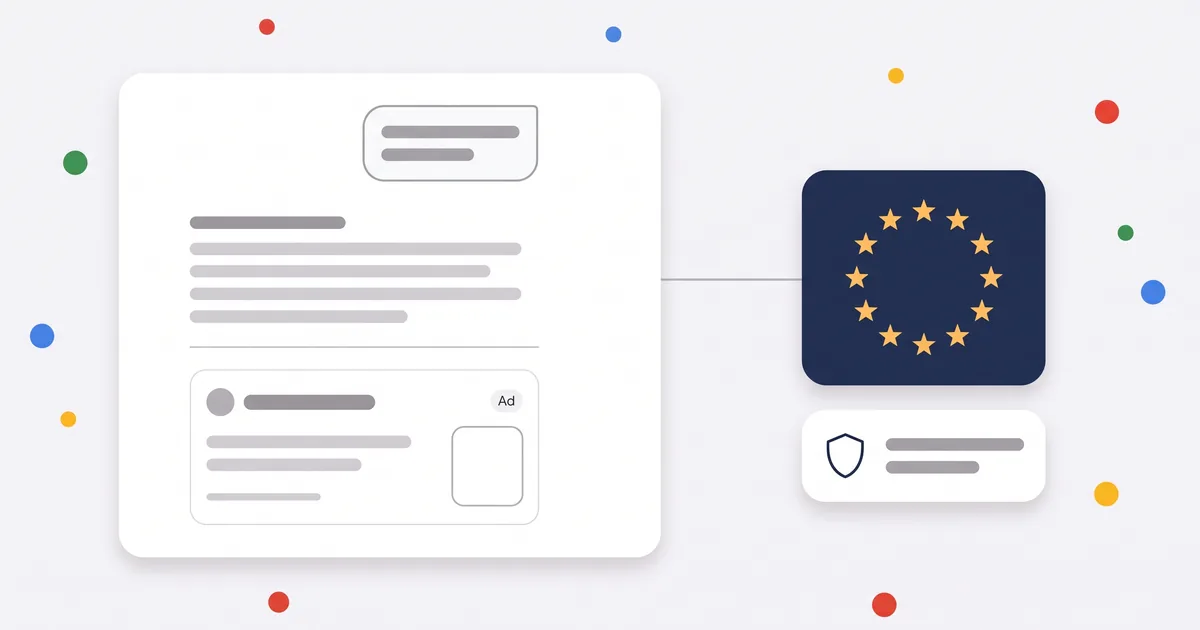
I work with European and UK clients, and over the past few weeks I've read a stack of ChatGPT Ads guides. Almost all of them are written from a US vantage point: US minimum budgets, US-only categories, US click data. The problem is that ChatGPT Ads doesn't behave the same way in Europe, and none of the guides that just reword the American playbook say so.
The European rollout landed on August 24, 2026, with self-serve accounts opening a week later on August 31. Since then, two things have changed how you should think about this channel if you work in the EU or UK: personalized ad selection isn't currently available inside the European Economic Area, and a public ad repository is arriving by the end of December under the Digital Services Act. This post is about what those two rules actually change in practice.
TL;DR
ChatGPT Ads have been live across 31 European markets since August 24, 2026 — the 27 EU member states plus Iceland, Liechtenstein, Norway, and Switzerland. Inside the EEA, ads are currently selected without personalization: only the current conversation, rough location, and language. By the end of December 2026, the Digital Services Act brings a public ad repository — visibility into competitors' campaigns on a known date.
31
European markets since 8/24
No personalization
across the EEA and Switzerland
Dec 2026
public ad repository (DSA)
🔄 Living guide — change history
This guide gets updated as European rules evolve. What's changed:
- September 2026: first version — European rollout, EEA personalization, the consent model, the DSA ad repository, allowed categories, and first steps for a European brand.
Quick answer
Do ChatGPT Ads work in Europe?
Yes — since August 24, 2026, ChatGPT Ads have been live across all 27 EU member states plus Iceland, Liechtenstein, Norway, and Switzerland, with self-serve accounts open since August 31, 2026. The catch versus the US: inside the European Economic Area, ad selection currently runs without personalization — only the current conversation, rough location, and language, with no memory or history of past conversations.
The European rollout
OpenAI announced the expansion to 31 European markets on August 18, 2026, and ads started showing to users on August 24, 2026. That covers all 27 EU member states plus Iceland, Liechtenstein, Norway, and Switzerland — grouped together in OpenAI's own communication as the "European market." Self-serve buying through Ads Manager opened a week later, on August 31, 2026, alongside India and parts of the Middle East and North Africa.
Ads in ChatGPT are only shown to logged-in users on the Free and Go plans. Plus, Pro, Business, Enterprise, and Edu users see no ads at all. Also ad-free: users under 18, Temporary Chats, and the Atlas browser. A Free user can opt out of ads in exchange for lower message limits, under Settings → Ads controls.
Worth remembering: there are two different lists that get mixed up constantly — the list of markets where ads are shown to users (41 countries globally, including these 31 European ones) and the list of countries where a business can open a self-serve account (47 countries). For Europe the two line up — all 31 markets sit on both lists — but for some other regions they don't, so it's worth checking the specific market rather than assuming.
No personalization: what it actually means
This is the biggest difference from the US, and the part fewest European teams actually understand. Inside the European Economic Area and Switzerland, personalized ads aren't currently available. The ad isn't chosen based on who you are — only on what's happening in that specific conversation.
What's used
Current conversation, rough location, language
The ad is chosen based on the topic and intent of the conversation happening right now, plus the user's rough location and the language they're chatting in. That's the entire signal.
What's not used
Memory, past conversations, ad history
No access to past conversations, no memory of the user, no history of previously shown ads — everything that's part of the signal in the US currently doesn't exist in Europe.
The strategic consequence: in Europe, there's currently no audience layer for an average message and average creative to hide behind. In the US, a campaign with weaker targeting can partly compensate through narrow audiences and behavioral history. In Europe that safety net doesn't exist — context hints (the free-text description of a conversation topic set at the ad group level) and the creative itself carry the entire mechanism. If they don't match the topic and tone of the conversation, the ad simply won't show where it should.
It's also worth knowing that opting out in Europe doesn't remove ads entirely — it only changes which ads a user sees. A European user who has turned off personalization (wherever it's available) still stays in the ad inventory; the selection just runs through a different path.
The consent model and oversight
Oversight of ChatGPT Ads in Europe sits with OpenAI Ireland Ltd, designated as the data controller, with Ireland's Data Protection Commission (DPC) as the competent regulator — the same model several other large tech companies with European headquarters in Ireland use.
When personalization is eventually introduced in Europe, it will be built on explicit user consent, not on a "legitimate interest" basis, which in other contexts has often been used as a workaround. The privacy policy was updated on August 14, 2026, ahead of the European launch.
It's worth staying realistic about what an advertiser can actually get out of this: an advertiser never receives conversation content, history, memories, name, email, precise location, or IP address — only aggregated performance data. That's true globally, not just in Europe, but combined with the absence of personalization it means a European advertiser is working with less signal than a US counterpart, on both sides of that line.
DSA: a public ad repository by end of 2026
On August 31, 2026, the European Commission designated ChatGPT a Very Large Online Search Engine (VLOSE) under the Digital Services Act, based on 159.1 million monthly EU users. That designation carries concrete obligations, with a compliance deadline of end of December 2026.
What the VLOSE designation actually requires
Per-ad transparency (Art. 26), a ban on profiling minors for advertising (Art. 28(2)), and a public ad repository retained for a year (Art. 39) — covering ad content, advertiser name, the period an ad ran, targeting parameters, and reach.
In practice, that's "Meta Ad Library for ChatGPT" — just with a known date for when it starts working. For advertisers, it means competitors' campaigns, their copy, run dates, and targeting will become publicly visible by the end of the year. Whoever prepares to use that for competitive research heads into 2027 with a level of visibility that hasn't existed on any other AI platform so far.
The categories that hurt Europe
The policy in effect since August 31, 2026 (openai.com/policies/ad-policies) currently allows only a limited set of consumer categories. For three categories European consultants and agencies ask about the most — financial services, healthcare, and legal services — advertising is currently permitted only for US-based advertisers, with manual approval.
| Category | Status in Europe |
|---|---|
| eCommerce, household & consumer goods | Allowed |
| Travel & entertainment | Allowed |
| Digital products | Allowed |
| Education & local services | Allowed |
| Financial services | US-only |
| Healthcare | US-only |
| Legal services | US-only |
That's a large, widely overlooked demand gap. A European clinic, law firm, or fintech currently cannot advertise on ChatGPT no matter how much budget they have — the category is locked at the policy level, not the account level. If you're working with a client in one of those three verticals, this is the first thing to check, before any pitch goes out.
What a European brand should do now
The order I follow when a European client asks whether they should get into ChatGPT Ads.
Frequently asked questions
Which European countries do ChatGPT Ads run in?▼
Can I target by audience in the EU?▼
What is the DSA ad repository, and when is it coming?▼
What if my country isn't on the supported list?▼
Thinking about ChatGPT Ads for a European account?
I help European and UK brands figure out whether ChatGPT Ads is worth testing, and get context hints, tracking, and budget set up correctly before the first ad goes live. On a free 20-minute intro call I go through your case.
Free 20-minute intro callChatGPT Ads service
Setup, targeting, and management of ChatGPT Ads campaigns for European accounts.
ChatGPT Ads: The Complete Guide
A full walkthrough of formats, targeting, buying, and what real results actually look like.
ChatGPT Ads vs Google Ads
Where each channel wins, and how to combine them inside one budget.
Europe plays by its own rules — without personalization, context hints and creative carry the entire mechanism, and a public ad repository arriving by year-end changes how much you can see about competitors. Whoever understands that before the pitch has an edge the American playbook doesn't cover.
Free intro call
A call about your Google Ads plan
In 20 minutes we go through your goal, budget and first step. If you need deeper work on the account, I tell you whether that is consulting ($200/hr) or a Deep Audit.
What the call covers:
- Your goal and budget
- What I would look at first
- The next step, with no obligation
No spend condition. I reply within 24 hours on weekdays.