
TL;DR
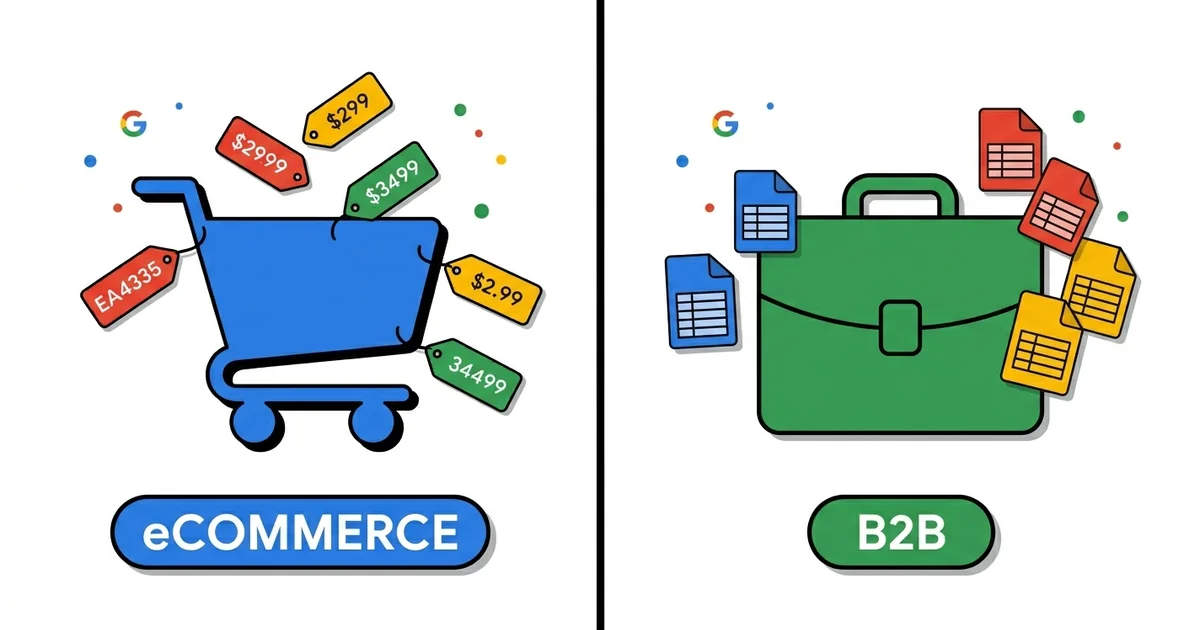
eCommerce and B2B Google Ads strategies are fundamentally different — customer journey, metric priorities, bidding strategies, and conversion tracking aren't the same. I recommend a tailored approach because applying the wrong strategy wastes money.
2
Models
8
Key differences
4+4
Strategies
1
Right approach
"We're running Google Ads but not seeing results."
When I hear this, my first question is: is your strategy tailored to your business model?
eCommerce and B2B have fundamentally different characteristics. Customer journey, decision-making process, conversion value, metrics you track — everything is different.
Yet I see the same approach applied to both: same campaign types, same KPIs, same expectations.
In this guide I cover the key differences and specific strategies for each model.
Quick answer
Does Google Ads strategy differ for eCommerce and B2B?
Yes — eCommerce and B2B require a fundamentally different Google Ads approach because they have different customer journeys, KPIs, and conversion values. There are 8 key differences between the two models and 4 distinct strategies for each. Applying the same strategy to both models is the most common reason campaigns waste budget without results.
Why eCommerce and B2B differ in Google Ads
Before diving into specific tactics, you need to understand the fundamental differences between the two models.
eCommerce: User knows what they want, searching where to buy. "Buy Nike Air Max 90 white" — intent is clear, cycle is short, conversion is purchase.
B2B: User has a problem, searching for a solution. "How to automate invoicing" — just researching options, cycle is long, conversion is a lead.
This difference dictates everything else — from campaign types to how you measure success.
Key differences — comparison
I recommend understanding the direct differences between models before defining strategy.
| Aspect | eCommerce | B2B |
|---|---|---|
| Sales Cycle | Minutes to days | Weeks to months |
| Decision Makers | 1 person | 2-10 people |
| Touchpoints | 1-5 interactions | 10-50+ interactions |
| Primary conversion | Purchase (with value) | Lead (form, demo, call) |
| Value | $20 - $800 (typical) | $2,000 - $200,000+ |
| Volume | High (hundreds of transactions) | Low (dozens of leads) |
| Primary KPI | ROAS, Revenue, Conversion Rate | CPL, Lead Quality, SQL Rate |
| Key campaigns | Shopping, PMax, Brand Search | Non-Brand Search, Remarketing |
Important
Ignoring these differences leads to applying the wrong strategy. Shopping is rarely relevant for classic B2B lead-gen (no product catalog), but B2B distributors and webshops with an online catalog do run it. Lead-gen tracking doesn't give ROAS for eCommerce. Tailor the approach to the model.
Google Ads strategy for eCommerce
For eCommerce, Google Ads strategy focuses on quick conversion, high ROAS, and Shopping campaigns as the key channel.
Shopping campaigns — heart of eCommerce strategy
For most eCommerce businesses, Shopping campaigns drive 60-80% of revenue from Google Ads. Visual format, price pre-qualification, high intent.
- Feed quality is #1 priority — title optimization, attributes, custom labels for segmentation
- Bidding: Target ROAS with dynamic conversion values (send actual transaction value)
- Segmentation: Custom labels by margin, best-sellers, seasonality
- Control: Negative keywords for irrelevant searches
Search campaigns
Brand Search for protection + Non-Brand Search for supplemental volume. Shopping > Search for most eCommerce categories.
- Brand: Mandatory — competitors can show on your brand
- Non-Brand: Generic searches ("Nike sneakers", "bluetooth headphones")
- Categories: Mid-funnel ("best running shoes")
Remarketing — recovery strategy
The large majority of visitors don't buy on their first visit. Remarketing is essential for converting "almost purchased" transactions.
- Cart Abandoners (1-7 days): Aggressive approach, maybe with incentive (10% off)
- Product Viewers (3-14 days): Dynamic product ads (show product they viewed)
- Past Customers (30-180 days): Cross-sell, upsell, new products
Performance Max — scaling with caution
PMax is an automated channel covering all Google inventory (Search, Shopping, Display, YouTube). Use for scaling when you have stable ROAS from Shopping/Search.
- When to use: After you have 50+ conversions monthly and stable ROAS
- Asset groups: Segment by categories or best-sellers
- Caution: PMax can cannibalize Brand Search — monitor search term reports
Related guide
More on Shopping campaigns: Google Shopping guide — how to launch and optimize
Google Ads strategy for B2B
For B2B, Google Ads strategy focuses on lead quality (not volume), longer sales cycle, and offline conversion tracking.
Search campaigns — focus on intent keywords
For B2B, Search is the dominant channel. Shopping is rarely relevant for classic lead-gen (no product catalog), though B2B distributors and webshops with an online catalog do run it. Display has limited impact. Cover the full funnel, but biggest budget on high-intent.
- Problem keywords: "how to reduce IT costs" — low intent, lower CPC
- Solution keywords: "IT outsourcing services" — medium intent, medium CPC
- Product keywords: "cloud ERP for manufacturing" — high intent, higher CPC
- Competitor keywords: "SAP vs Oracle" — high intent, high CPC
Content/Lead magnet strategy
B2B buyer doesn't want to leave contact info immediately. Offer free content (whitepaper, checklist, webinar) as first step.
- Top-of-funnel: Problem-based content ("How to reduce costs" → "Download free checklist")
- Mid-funnel: Solution content (case study, demo video)
- Bottom-funnel: Direct offer (demo, consultation)
Remarketing — nurture through longer cycle
B2B remarketing is different — longer consideration period (30-90 days), more touchpoints, focus on value nurture.
- Blog Readers (30 days): Lead magnet, webinar invite
- Resource Downloaders (60 days): Case study, demo offer
- Pricing Page (14 days): Direct offer, consultation (high-intent segment)
- Demo No-Shows (7 days): Reschedule, alternative content
Offline Conversion Import — critical difference
In eCommerce, conversion = sale. In B2B, conversion = lead. But not all leads are equal. Offline import solves the quality problem.
- Problem: You optimize towards form submissions, getting volume but not quality
- Solution: Save GCLID with each lead → track through sales pipeline → import "SQL" or "Won" back to Google Ads
- Impact: Google learns which lead types close. Volume may drop, but quality drastically rises.
Related guides
Conversion tracking guide for offline import setup & Remarketing guide for nurture strategy.
KPIs and measuring success
I recommend different KPIs for eCommerce and B2B because optimizing towards wrong metrics wastes money.
eCommerce
Primary KPIs
ROAS (Return on Ad Spend) — revenue / cost
Revenue — total revenue from campaigns
Conversion Rate — % visitors who buy
AOV (Average Order Value)
CPA (Cost per Acquisition)
B2B
Primary KPIs
CPL (Cost per Lead) — but caution, it's not all about volume
Lead Quality Score — % qualified leads
SQL Rate — % leads that become Sales Qualified
Pipeline Value — total value of potential deals
Cost per SQL (true KPI, not CPL)
| Metric | eCommerce Benchmark | B2B Benchmark |
|---|---|---|
| CPC (average) | $0.50 - $2.50 | $3.00 - $15.00+ |
| Conversion Rate | 2% - 5% | 5% - 15% (lead form) |
| Target ROAS | 300% - 500%+ | N/A (lead-gen model) |
| CPA / CPL | $15 - $80 (per purchase) | $80 - $800+ (per lead) |
| Conversions monthly | 50-500+ | 10-50 |
Budget and expectations
Realistic expectations around budget and results vary drastically between eCommerce and B2B.
| Aspect | eCommerce | B2B |
|---|---|---|
| Minimum budget | $800 - $1,500/month | $2,500 - $4,000/month |
| Recommended starting | $2,000 - $5,000/month | $5,000 - $8,000/month |
| Time to results | 2-4 weeks (first data) | 1-3 months (quality leads) |
| Scaling | Linear growth (2x budget = ~2x revenue) | Non-linear (higher budget ≠ 2x leads) |
Budget rule
eCommerce: Budget = 10% expected revenue (e.g., want $15K revenue → $1.5K ad spend). B2B: Budget > 3x CPC × 30 conversions (e.g., $8 CPC → min. $720/month, but I recommend 5-10x for stability).
Most common mistakes by model
Each model has specific mistakes I see with new clients. I recommend avoiding them.
eCommerce
Critical mistakes
- Ignoring feed optimization — feed is the foundation of Shopping, not title/description
- Same bid for all products — high-margin products need higher bids, low-margin lower
- No remarketing segmentation — cart abandoners ≠ browsers, different approach
- Focus on CTR instead of ROAS — click isn't sale, are you paying just for clicks or for revenue?
B2B
Critical mistakes
- Optimizing towards form fills without quality metrics — volume ≠ quality, track SQL rate
- Remarketing windows too short — B2B cycle is 30-90 days, not 7
- Ignoring offline conversions — you lose most important feedback for quality
- Keywords too generic — "software" isn't specific enough
- Expecting eCommerce-level volume — B2B is inherently lower volume, focus on quality
Frequently asked questions
Can the same team run both eCommerce and B2B campaigns?▼
Which model is easier to start with?▼
Does PMax work for B2B?▼
How much budget for B2B?▼
How to measure ROI for B2B when sales cycle is 6 months?▼
What if I run hybrid model (e.g., SaaS with self-serve + enterprise)?▼
Need help with Google Ads strategy?
I work with eCommerce and B2B clients on tailored Google Ads strategies. Free consultation includes analysis of your current account setup and optimization recommendations.
Schedule free consultationGoogle Ads for eCommerce
Specialized strategies for online stores
Google Shopping Guide
Complete setup and optimization of Shopping campaigns for eCommerce
Remarketing Guide
Strategies for cart abandonment and lead nurture
Conversion Tracking Guide
Offline conversion import and quality tracking for B2B
How Much Does Google Ads Cost
Budget benchmarks and expectations for eCommerce and B2B
Frequently asked questions — eCommerce vs B2B Google Ads
Which campaign type is best for eCommerce?▼
How do I measure B2B Google Ads campaign success?▼
Does Google Ads work for B2B with long sales cycles?▼
What budget is needed for eCommerce vs B2B?▼
Free video audit
Get a Personalised Video Audit of Your Google Ads Account
I'll record a 15-minute walkthrough of your campaigns showing exactly where you're losing money and what to fix first.
Free personalised video audit
Want a video walkthrough of your Google Ads account?
I'll personally record a 15-minute video walking through your campaigns, showing you where you're losing money and giving you 3 specific things to fix immediately. No sales pitch — just value.
What you get:
- 15-min personalised video analysis
- 3 specific quick wins to implement
- Budget & bidding recommendations
Requirements:
- Ad spend: $1,500+/month
- Active account for 3+ months
- eCommerce or Lead Gen business
Limited to 5 audits per month. Response within 48 hours.