
TL;DR
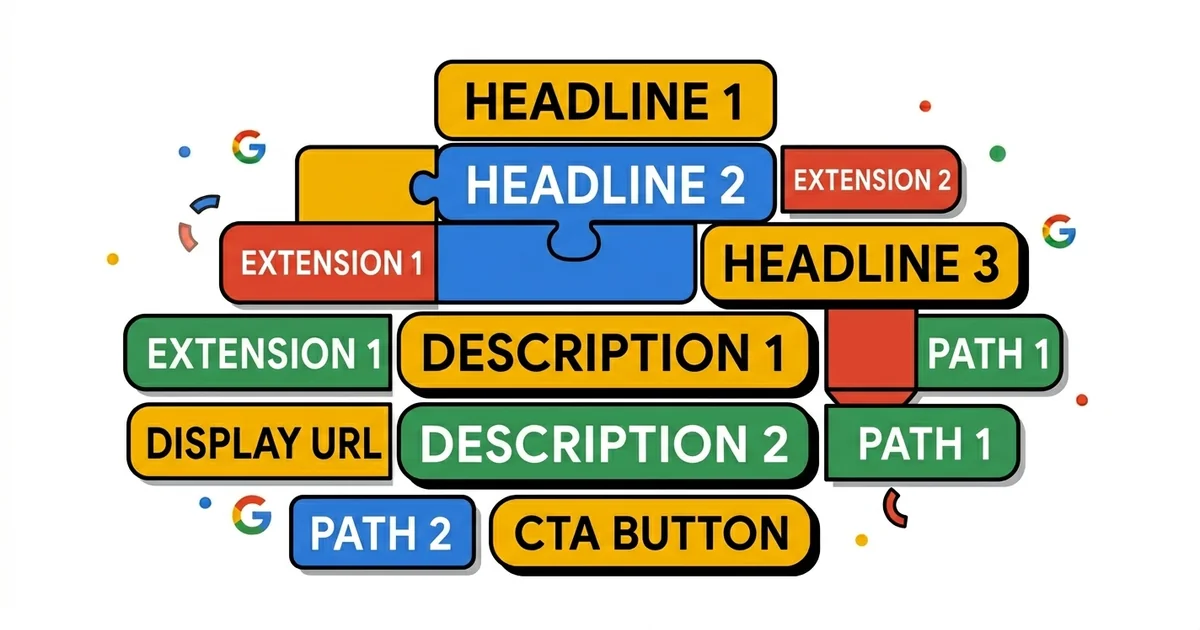
Responsive Search Ads are the only text ad format in Google Ads. The key to success is not 15 headlines — it is 7-8 precisely distributed by role. This guide gives you the exact framework I use on client accounts.
7-8
headlines, not 15
336
combinations (enough)
59%
use AI for ad copy
7
headline types
Quick answer
How many headlines should a Responsive Search Ad have?
Responsive Search Ads (RSA) are the only text ad format in Google Ads and allow up to 15 headlines, but the optimal number is 7-8 headlines precisely distributed by role (7 headline types), giving 336 possible combinations — more is unnecessary and dilutes relevance. Surveys show 59% of advertisers already use AI to write ad copy.
Why the RSA Format Dominates in 2026
Since June 30, 2022, Responsive Search Ads have been the only text ad type you can create or edit in standard Search campaigns. Expanded Text Ads (ETAs) can no longer be created or edited, but existing ones still serve and can be paused or removed (as of October 2026). Every new text ad you write in a standard Search campaign today is an RSA.
An RSA is an ad format inside a Search campaign, not a campaign in its own right. If you are still setting up campaign structure, budgets and bidding around these ads, start with the Google Search campaigns guide, then come back here for the copy.
The problem? Most advertisers use RSAs incorrectly. They fill all 15 headlines because Google suggests it, give no thought to angle distribution, then wonder why their Ad Strength reads "Excellent" whilst CTR is below average.
According to the State of PPC 2026 report (1,306 respondents), 59% of PPC professionals now use AI to write ad copy — up from 42% two years ago. But AI without a framework produces generic copy. And generic copy in RSAs means your ad blends into every other result on the page.
From my experience
After managing Google Ads accounts across eCommerce, Lead Gen, and local services — RSAs with 7-8 well-distributed headlines consistently outperform RSAs with 15 headlines on both CTR and conversions. The reason is mathematics, not opinion.
In this guide you will get the exact framework I use on client accounts: how many headlines to write, which type goes in which slot, how to adapt tone to audience temperature, and how to test and iterate.
What Are Responsive Search Ads and How They Work
Responsive Search Ads are the ad format in Google Search campaigns where you input multiple headlines (up to 15) and descriptions (up to 4), and Google's machine learning automatically combines and serves the combinations that are most relevant for each individual searcher.
What you give Google
- Up to 15 headlines — each up to 30 characters
- Up to 4 descriptions — each up to 90 characters
- Final URL — your landing page
- Display path — shown URL (2 fields x 15 characters)
What Google does with it
Google shows 3 headlines + 2 descriptions in each ad impression. It combines them based on signals: keyword, device, location, time of day, user history. The goal: find the combination with the highest probability of a click and conversion.
The key rule
Every headline must make sense alongside any other headline. Google will combine headline 1 with headline 8 and headline 12 — if two headlines say the same thing or contradict each other, the ad loses quality.
Why 7-8 Headlines, Not 15
This is the most important concept in the entire guide. Google allows 15 headlines, but that does not mean you should use all 15.
The reason is mathematical. Google picks 3 of your headlines for each impression. The number of possible combinations depends on how many headlines you have:
| No. of headlines | 3-headline combinations | Min. impressions to learn | Status |
|---|---|---|---|
| 7 | 210 | ~21,000 | Optimal |
| 8 | 336 | ~33,600 | Optimal |
| 10 | 720 | ~72,000 | Too many |
| 15 | 2,730 | ~273,000 | Data poverty |
The calculation: each combination needs a minimum of ~100 impressions for Google to evaluate its potential. With 15 headlines, you need 273,000 impressions before the algorithm has sufficient data. With 8 headlines — only 33,600.
The rule: More headlines = more combinations = less data per combination = slower learning = worse results.
This does not mean you should never use 15 headlines. If your account generates 100,000+ impressions per month per ad group, you can afford more. But for most accounts — 7-8 headlines is the sweet spot.
7 Headline Types That Cover Everything
Instead of writing random headlines and hoping Google finds a good combination, use angle-based slot distribution. Each headline has a clear role — and together they cover the complete persuasion journey.
Relevance Anchor
Signal that the ad is relevant to the search query.
Examples:
- "HR Software for SMEs"
- "Emergency Boiler Repair London"
- DKI: {KeyWord:Anti-Ageing Skincare}
Value Proposition
Your core offer plus the primary benefit.
Examples:
- "Dermatologist-Tested Formulas"
- "More Leads, Lower Cost Per Click"
- "All-in-One Platform for Teams"
USP / Benefit
Why you are different from the competition.
Examples:
- "Results in 30 Days or Your Money Back"
- "No Contract — Cancel Anytime"
- "Engineer On-Site Within 2 Hours"
Social Proof
Trust and credibility signals.
Examples:
- "Trusted by 15,000+ UK Customers"
- "4.9/5 Stars on Trustpilot"
- "Which? Recommended Provider"
Risk Removal
Remove the barrier to taking action.
Examples:
- "Free 14-Day Trial"
- "30-Day Money-Back Guarantee"
- "No Win No Fee — Zero Upfront Cost"
Call-to-Action
The clear action you want them to take.
Examples:
- "Request a Free Audit Today"
- "Start Your Free Trial Now"
- "Call Us — We're Available 24/7"
Lead Angle x2 (variable)
Double down on your strongest signal — which one depends on traffic temperature (more on this in the next section). For cold traffic: a second Problem/Pain headline. For warm: a second USP. For hot: a second Social Proof.
Why this works
When each headline has a different role, every combination Google serves covers a different persuasive angle. The result: your ad is relevant to a wider range of users and motivations. Instead of 7 variations of the same message — you get 7 complementary messages.
Traffic Temperature Approach — Match Your Tone to the Audience
Not all searchers are the same. Someone searching "what is CRM software" is in a completely different mindset from someone searching "HubSpot pricing UK". Your RSA needs to match that temperature.
| Temperature | Search intent | H7 should be | CTA tone |
|---|---|---|---|
| Cold | Research, education | Problem/Pain (second variant) | "Learn More", "See How It Works" |
| Warm | Comparison, evaluation | USP or Value Prop (second variant) | "Compare Plans", "Book a Free Demo" |
| Hot | Purchase, booking | Social Proof or Risk Removal (second variant) | "Get Started Today", "Order Now" |
In practice, this means creating 2-3 RSAs for the same service — one per traffic temperature. All share the same foundation (H1-H6), but H7 and the CTA tone differ.
Practical example — skincare eCommerce
A skincare brand has an ad group for "best anti-ageing serum UK" (hot traffic). H7 becomes a second Social Proof: "Trusted by 15,000+ UK Customers". CTA: "Shop Now — Free Next-Day Delivery Over £50". For the cold query "how does retinol work", H7 becomes Problem/Pain: "Tired of Products That Don't Deliver?", CTA: "See the Science".
How to Write an RSA Step by Step
Here is the exact process I follow on every client account. Four phases, in a clear order.
Here is what a completed RSA looks like for a UK skincare eCommerce brand using this framework:
| Slot | Type | Example Headline |
|---|---|---|
| H1 | Relevance Anchor | Premium Anti-Ageing Skincare UK |
| H2 | Value Proposition | Dermatologist-Tested Formulas |
| H3 | USP / Benefit | Visible Results in 28 Days |
| H4 | Social Proof | Trusted by 15,000+ UK Customers |
| H5 | Risk Removal | Free Next-Day Delivery Over £50 |
| H6 | Call-to-Action | Shop the Full Range Today |
| H7 (Cold) | Problem/Pain | Tired of Products That Don't Work? |
| H7 (Hot) | Urgency / Scarcity | Spring Sale — 20% Off This Week |
Description Strategy
Headlines attract attention — descriptions close the deal. Google shows 2 descriptions from your 2-4. Each description has up to 90 characters and should expand on the message in the headlines, not repeat it.
Problem + Solution
Validate the user's pain and offer the solution. Include the keyword — Google bolds it.
"Struggling with blocked drains? Our engineers resolve the problem same day with a 12-month guarantee."
Proof + CTA
Build trust with a concrete proof point and close with a clear call to action.
"500+ five-star reviews across London. Call now — engineer on-site within 2 hours, 24/7."
Offer + Urgency (optional)
Use ONLY when there is a genuine deadline. False urgency destroys trust.
"20% off all orders this bank holiday weekend. Limited stock — order by Sunday midnight."
Pinning — Yes or No?
Pinning lets you "lock" a specific headline to position 1, 2, or 3. It sounds useful, but in 90% of cases it hurts performance.
The rule: Default = DO NOT PIN. Pinning restricts Google's optimisation and reduces the number of combinations the algorithm can test.
When pinning is justified
- Regulatory requirements — financial services, healthcare (disclaimer must be visible)
- Brand guidelines — brand name must appear in headline 1
- Critical relevance — keyword MUST appear in headline 1 for a specific campaign
When it is NOT justified
- "I want this headline to show more often" — let Google optimise
- "This is my best headline" — if it is, Google will favour it automatically
- "Every headline fixed to an exact position" — this is the ETA approach, not RSA
Most Common RSA Mistakes and How to Avoid Them
Mistake: All 15 headline slots filled
Fix:
Use 7-8 headlines. More means data poverty. Each additional headline reduces the volume of data per combination, slowing the algorithm's learning.
Mistake: All headlines say the same thing
Fix:
Use angle-based distribution. Each headline has a different role: relevance, benefit, proof, risk removal, call to action. 7 angles = 7 reasons to click.
Mistake: Descriptions repeat the headlines
Fix:
Descriptions should EXPAND the message. The headline says "Trusted by 15,000+ UK Customers", the description explains: "Join brands that reduced CPA by 40% within their first 90 days."
Mistake: Everything pinned to positions
Fix:
Only pin when regulation requires it. Otherwise, let Google optimise. Over-pinning converts your RSA into an ETA — you lose all the benefits of automatic combination.
Mistake: Using Ad Strength as your only metric
Fix:
Ad Strength is Google's input signal, not a performance metric. Aim for "Good" or better, but measure success by CTR, conversions, and CPA — not the score shown in the interface.
Mistake: Fake urgency in descriptions
Fix:
"Today only!" that runs all year destroys trust. Use D3 (urgency) ONLY when you have a genuine deadline. Otherwise — skip it and stick to 2 descriptions.
RSA Testing — The Iteration Loop
Writing the RSA is only the beginning. Real results come through systematic testing and iteration. I use a four-step cycle repeated every 2-8 weeks.
| Quadrant | Impressions | Performance | Action |
|---|---|---|---|
| Champions | High | High CTR/Conv | Keep and learn from them |
| Hidden Gems | Low | High CTR/Conv | Duplicate the angle in a new RSA |
| Silent Killers | High | Low CTR/Conv | Replace — consuming impressions without results |
| Trash | Low | Low CTR/Conv | Remove and write a new headline |
How long to wait before analysing
Minimum 2 weeks and 1,000+ impressions per RSA variant. Without that, the data is unreliable. For lower-volume accounts, wait 4 weeks. Never change an RSA within the first 7 days — give Google time for its learning period.
Frequently Asked Questions About RSA
How many RSAs should I have per ad group?+
Does an "Excellent" Ad Strength guarantee better results?+
Should I use AI to write RSA headlines?+
How frequently should I update my RSAs?+
What if I do not have enough impressions for 7-8 headlines?+
How does RSA work alongside Smart Bidding?+
Does RSA replace the need for A/B testing?+
Conclusion
RSA is not "fill 15 headlines and wait". It is a systematic framework where each headline has a clear role, where tone follows traffic temperature, and where results improve through iteration — not guesswork.
Key takeaways:
- 7-8 headlines — the mathematics is clear, data poverty is real
- Angle-based distribution — each headline covers a different persuasive angle
- Traffic Temperature — adapt H7 and your CTA to match search intent
- Do not pin — unless regulation requires it
- Iteration Loop — test, diagnose, iterate every 2-8 weeks
Want someone to write RSAs that actually convert?
I manage Google Ads accounts for eCommerce, Lead Gen, and local businesses across the UK. Free audit of your account — including a full analysis of your existing RSAs.
Request a free auditRelated Guides
Quality Score Guide
How to improve QS and bring your cost per click down
Google Ads Keyword Guide
Research, match types and campaign structure
Google Ads Mistakes
The most common mistakes and how to avoid them
How Much Does Google Ads Cost?
Real costs, budgets, and ROI calculation
Negative Keywords Guide
Protect your budget from irrelevant searches
Conversion Tracking Guide
Measuring results correctly in Google Ads
Last updated: July 2026 · Author: Slobodan Jelisavac, Google Ads Consultant · Reading time: ~14 min
Free video audit
Get a Personalised Video Audit of Your Google Ads Account
I'll record a 15-minute walkthrough of your campaigns showing exactly where you're losing money and what to fix first.
Free personalised video audit
Want a video walkthrough of your Google Ads account?
I'll personally record a 15-minute video walking through your campaigns, showing you where you're losing money and giving you 3 specific things to fix immediately. No sales pitch — just value.
What you get:
- 15-min personalised video analysis
- 3 specific quick wins to implement
- Budget & bidding recommendations
Requirements:
- Ad spend: $1,500+/month
- Active account for 3+ months
- eCommerce or Lead Gen business
Limited to 5 audits per month. Response within 48 hours.